Understanding the Spam Act 2003 and ACMA
A few months back, a brand came to us in a genuine panic. They had collected customer mobile numbers at checkout solely for shipping updates, and someone on their team decided to blast promotional texts to that list without separate marketing consent. A recipient reported them to the Australian Communications and Media Authority (ACMA).
Under Australia's Spam Act 2003, that single oversight is a serious breach. Penalties start at up to $220,000 for an individual contravention and scale up to $2.1 million for corporations with repeat offences. ACMA actively enforces these rules. This is not theoretical regulation that sits forgotten on government shelves.
The baseline rule in Australia is express consent. Express consent means a customer has deliberately and actively agreed to receive promotional messages from your specific brand. It cannot be assumed, and it cannot be inferred simply because someone bought a product from you six months ago.
Some operators try to lean on inferred consent clauses to skip transparent opt-ins. In my books, building your growth strategy inside a legal grey area is reckless. You need explicit, clear permission before a single marketing text leaves your account.
Opt-Out Mechanics and Sender Identification Rules
Getting opt-in consent is only half the battle. Every promotional text you send across Australian networks must also provide a frictionless method for the subscriber to opt out. In practice, this is standard text like "Reply STOP to opt out" or an unsubscribe link.
Australian law dictates that opt-out requests must be honoured within five working days. If you are using modern software, this suppression happens instantly, so treat five days as a legal ceiling rather than a standard benchmark. You cannot charge a subscriber to opt out, nor can you require them to log into an account or fill out a survey to complete it.
Crucially, your unsubscribe mechanism and your sender identification details must remain fully operational for at least 30 days after the message is sent. You cannot fire off a flash-sale campaign on a Friday and disconnect the number the following week.
Your business identity must also be immediately clear. Your registered trading name or Australian Business Number (ABN) needs to appear within the message body or sender details. If recipients cannot immediately identify who is texting them, you are non-compliant.
Choosing Between Branded Sender IDs and Long Codes
Once compliance is locked down, you face an operational decision around sender numbers that trips up dozens of brands. In Australia, you generally pick between two primary options: Branded Sender IDs and Long Codes (standard 10-digit mobile numbers).
Branded Sender ID (Alpha Tag)
A branded sender ID displays your business name directly in the recipient's messaging header instead of a phone number. It looks exceptionally clean, establishes immediate trust, and takes roughly 7 to 10 days to verify through regulatory registries. However, it comes with heavy functional limitations.
Branded sender IDs are strictly one-way broadcast channels. They do not support incoming replies, and they do not support MMS (multimedia messaging like images or GIFs). If a customer tries to reply with a product question or a simple "STOP", the network will drop it.
Long Codes (Dedicated Numbers)
Long codes look like standard mobile numbers and take around 1 to 3 days to provision. Unlike sender IDs, long codes support full two-way messaging and MMS delivery. That operational difference is massive for ecommerce stores.
For the vast majority of our clients, we recommend long codes over branded IDs. Two-way messaging allows your team to handle abandoned checkout queries, collect product sizing replies, and solve support tickets directly within the text thread. That conversational capability drives far more revenue than a static brand name ever will.
Quiet Hours, Frequency, and Deliverability
SMS delivers incredible open rates, with the vast majority of messages opened within three minutes of delivery. Because SMS sits on a customer's personal device alongside texts from family and friends, poor sending hygiene will destroy your list faster than email ever could.
First, respect quiet hours. In Australia, sending promotional texts late at night or before standard daytime hours is the quickest way to spike unsubscribes and generate ACMA spam complaints. Always configure your sending windows inside your platform to prevent messages landing after hours in the recipient's local timezone.
Second, manage your frequency. A solid rule of thumb is keeping promotional campaigns to a few times a month, reserving higher-touch automation for triggered flows like abandoned carts or back-in-stock notifications. If you over-saturate SMS with generic daily discounts, your unsubscribes will spike and your carrier deliverability will suffer. That is a mistake.
Capturing SMS Consent the Right Way
Building a high-converting, compliant Australian SMS list requires deliberate setup across your acquisition touchpoints. Shortcuts here will inevitably contaminate your list with unverified profiles.
- Checkout boxes: Use a dedicated SMS opt-in field at checkout that remains unticked by default. Pre-ticked boxes do not constitute express consent.
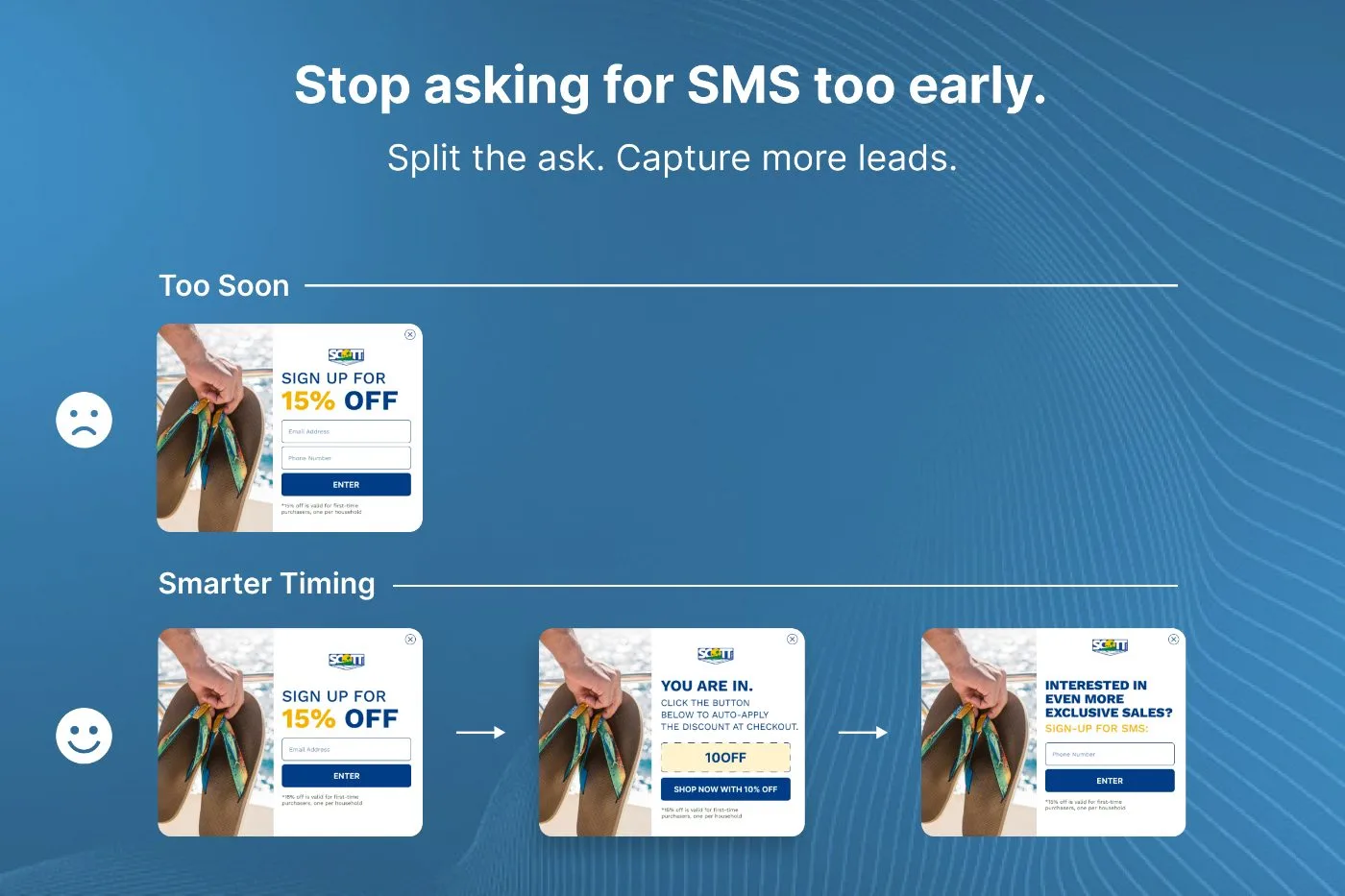
- Two-step popups: Keep your email and SMS capture separate. Ask for the email on step one, and offer an additional incentive on step two for their mobile number with explicit SMS consent copy.
- Keyword opt-ins: Promote a dedicated keyword (like "JOIN") where customers text your long code directly to opt into product alerts and VIP perks.
- Post-purchase forms: Capture consent on your order confirmation page while purchase excitement is high.
Never bury SMS marketing terms inside generic website terms of service. Consent must be standalone, transparent, and completely unambiguous to the customer at the exact moment they enter their phone number.
Running Australian SMS Through Klaviyo
For modern ecommerce brands, we run both email and SMS directly inside Klaviyo. Consolidating both channels onto one platform gives you a single customer profile, unified segmentation, and comprehensive reporting across all lifecycle stages.
Klaviyo handles Australian compliance requirements natively, including automated unsubscribe management, quiet hours enforcement, and support for both sender IDs and long codes. Instead of running disconnected tools with disjointed customer data, you can build unified trigger splits (such as sending an SMS only if a customer does not open an abandoned cart email within 4 hours).
Having your analytics and customer segments aligned under one roof saves countless operational hours and eliminates deliverability blind spots across your entire retention stack.
Final Thoughts
SMS marketing is one of the highest-converting channels available to ecommerce brands in Australia, but it leaves zero margin for legal carelessness. Prioritise explicit consent, set up two-way long codes to maximise engagement, and treat your subscriber's phone with respect. When done right, SMS will reliably sit among your top revenue drivers month after month.
Audit and Optimise Your SMS Strategy
If you want to ensure your Australian SMS setup is fully compliant, profitable, and integrated cleanly with your flows, take a look at our SMS campaign services to see how we build high-converting retention systems for growing brands.