Why Your Emails Are Getting Clicks But Not Sales
You’ve dialed in your email strategy:
- Open rates are healthy.
- Click-throughs are strong.
- Your segments are sharp, your flows are running, and your automations are doing their thing.
- But somehow… the revenue isn’t lining up.
This is something we see all the time: brands doing all the right things on the email side, and still not seeing the conversions they expect. It’s frustrating, especially when every metric inside your ESP says the campaign is working.
Here’s the truth: it’s not always your email that’s underperforming. Sometimes, the issue lives on the other side of the click.
Because email doesn’t close the sale. The store does.
Let’s talk about what might be happening after your email does its job, and why it matters just as much as everything leading up to it.
What Great Email Strategy Actually Looks Like
Let’s be clear: most brands today aren’t sending out random one-off blasts anymore. If you’ve invested in your email marketing strategy for e-commerce, chances are you’ve got a solid foundation in place.
You’re segmenting based on behavior and purchase history.
You’ve built lifecycle flows for welcome, post-purchase, and win-back journeys.
You’re using dynamic content to personalize messaging.
Your templates are mobile-optimized and on-brand.
In other words, you’re doing it right.
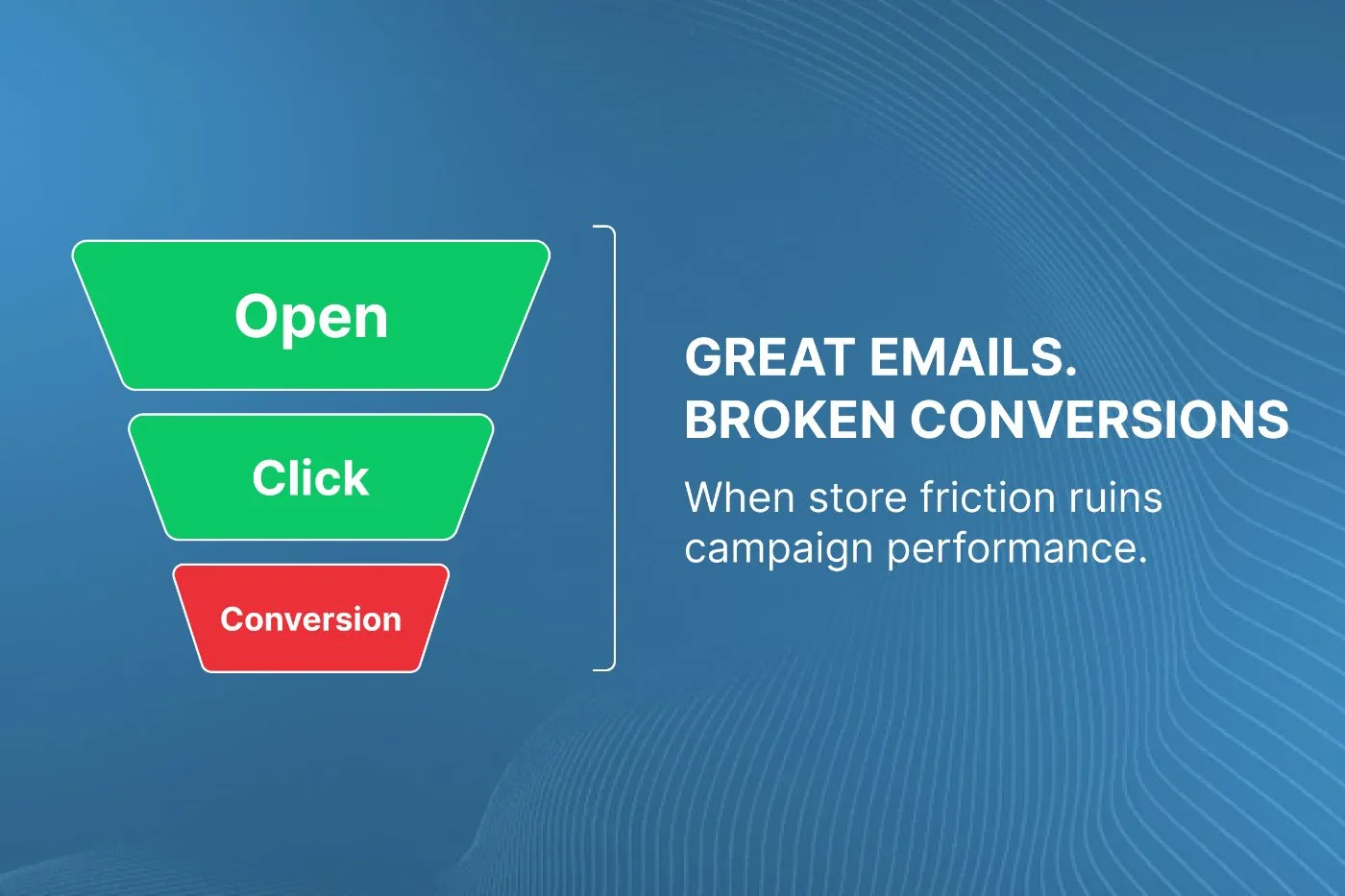
But here’s the curveball: even with all of that in place, many brands still see disappointing returns. Open rates are strong. Clicks are coming in. But sales? Flat.
It’s easy to assume something must be off in the email strategy, maybe the copy needs tweaking, maybe the offer isn’t strong enough. But often, the issue isn’t with the campaign. It’s that the campaign is doing its job, but the store isn’t ready to catch the handoff.
Because at the end of the day, email is the driver, not the destination. It gets people to the door. What happens once they walk in is an entirely different story.
When a Click Isn’t Enough
It’s easy to treat a high click-through rate as a win, and it is. It means your subject line worked, your creative landed, and your call-to-action was compelling enough to get someone moving.
But here’s the catch: a click is not a conversion.
Understanding your email conversion rate and how to improve it is key to turning engagement into actual revenue.
We’ve seen too many campaigns drive traffic to stores that simply aren’t ready to convert it. The product takes too long to load. The page feels cluttered or confusing. The messaging on the landing page doesn’t match what the email promised.
Here are some of the most common places we see things fall apart:
- Slow load times, especially on mobile, the customer bounces before they even see the offer.
- Unclear product pages, pricing, CTAs, or key details buried too far down.
- Mismatch between email and page, the offer mentioned in the email isn’t reflected, or the product is out of stock.
- Popups or distractions that get in the way of completing the purchase.
As email marketers, we can build smart, strategic campaigns, but if the store experience drops the ball, the entire funnel suffers. And truthfully, this part isn’t always under our control.
Still, if you’re looking at a well-performing campaign and scratching your head over why sales didn’t follow, it’s worth asking: what happened after the click?
The Disconnect Between Inbox and On-Site Experience
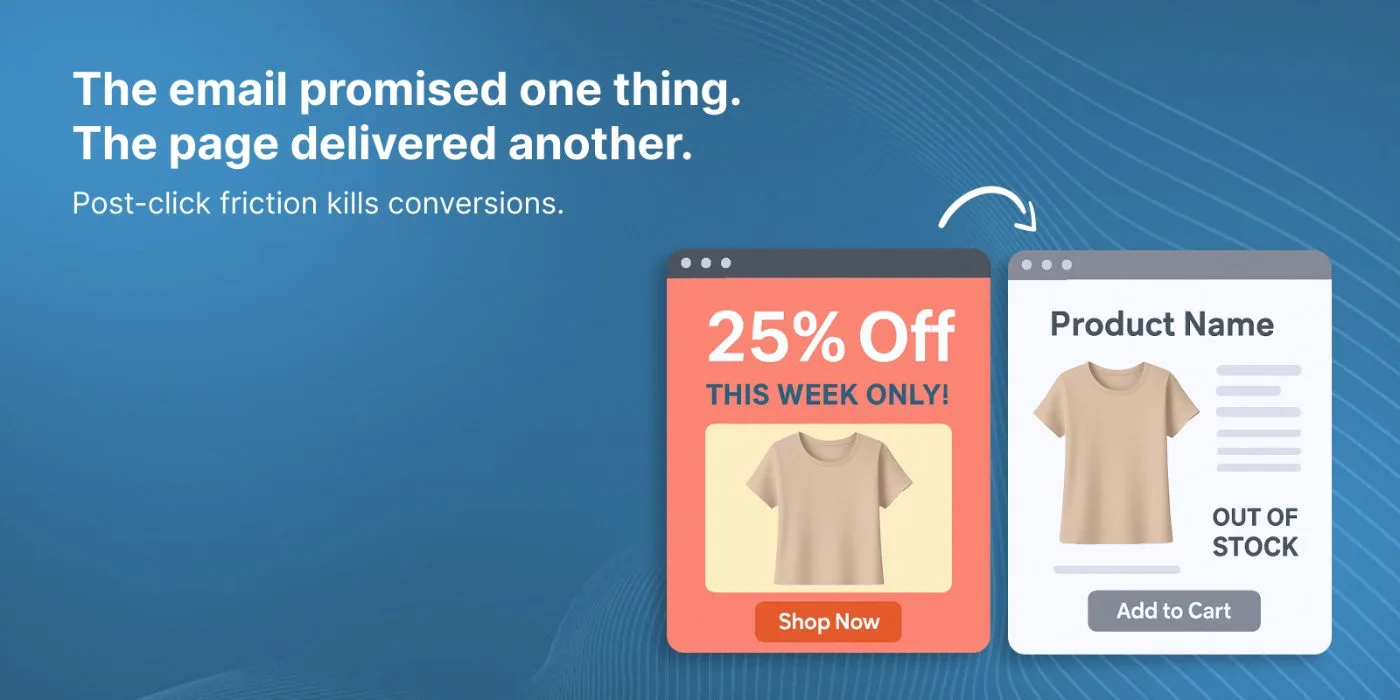
Every email sets an expectation.
Maybe you promised a limited-time discount. Maybe you highlighted a back-in-stock bestseller. Maybe you curated a product just for that specific segment.
But when the shopper clicks through and the page doesn’t reflect that message, the experience breaks. And so does trust.
We see this kind of friction more often than most brands realize:
- The discount code mentioned in the email isn’t auto-applied or visible anywhere.
- A promoted product is out of stock, or worse, the link is broken.
- The layout or content on the landing page feels generic, irrelevant, or outdated.
These aren’t just technical issues. They’re moments that create confusion and hesitation, two of the biggest conversion killers in ecommerce. When the path to purchase feels off, shoppers leave.
This kind of disconnect is subtle, but costly. It’s one of the most common reasons brands lose momentum between email engagement and actual revenue. It’s also a perfect example of what some refer to as “the leaky bucket” problem: when your campaigns are driving traffic, but your store experience quietly lets those potential conversions slip away.
How to Protect Your Email Performance Post-Click
Preventing drop-off doesn’t require a complete overhaul of your store, but it does require tighter collaboration between email and ecommerce teams.
Too often, email marketers are operating in isolation. The campaign gets built, the copy gets approved, and the email gets scheduled, all without reviewing what happens after the click. That gap can quietly cost a campaign its ROI.
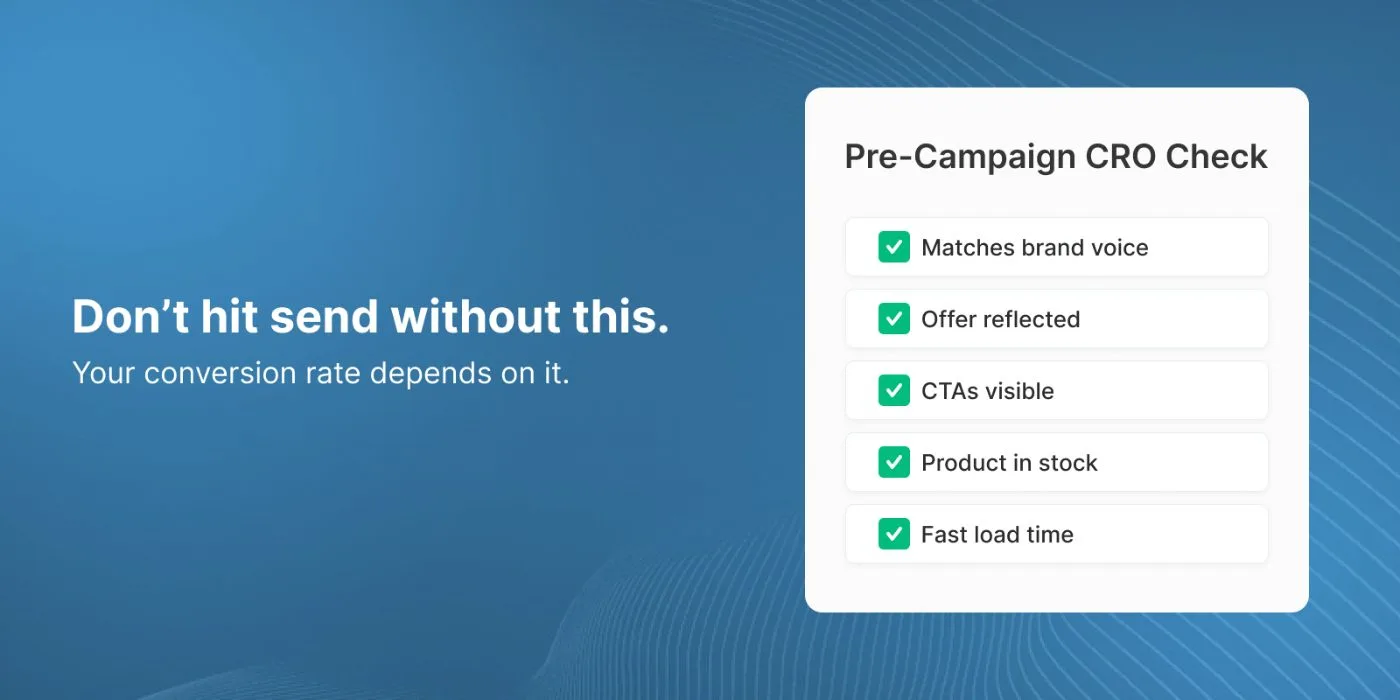
A few key questions to ask before hitting send:
- Is the landing page live, mobile-friendly, and loading quickly?
- Does the product still have inventory?
- Is the offer from the email clearly reflected on the page?
- Are CTAs easy to spot and act on, especially on mobile?
- Are popups or distractions going to interrupt the buying flow?
Even a five-minute cross-check between teams can prevent the kind of friction that kills conversions.
Some teams even use a pre-campaign CRO checklist to catch common issues ahead of time, broken links, outdated product info, missing CTAs, and align everyone before launch. Here’s a simple example of the kind of tool some brands use to stay consistent.
It’s a small step, but it protects the investment you’re making in every campaign.
Email ROI Isn’t Just About the Inbox
Email can be one of your highest-performing marketing channels, but only if the rest of the funnel holds up.
Even the best flows, the smartest segmentation, and the strongest creative won’t drive results if the store experience isn’t ready to support them. If your product pages aren’t optimized, your offers aren’t reflected, or your load times cause bounce, the campaign will underdeliver, no matter how good the email looks in your ESP dashboard.
If you want your email program to scale sustainably, the store needs to be part of the strategy.
Before you scale, it’s worth ensuring your Klaviyo account is properly warmed up and your deliverability is strong; otherwise, your best campaigns might never reach the inbox.
When the inbox and the on-site experience work together, everything gets easier:
- Conversions go up.
- Retention improves.
- Your marketing dollars stretch further.
At the end of the day, campaigns deserve landing experiences that live up to the work that went into them. And your customers? They deserve an experience that’s as seamless after the click as it was before it.